
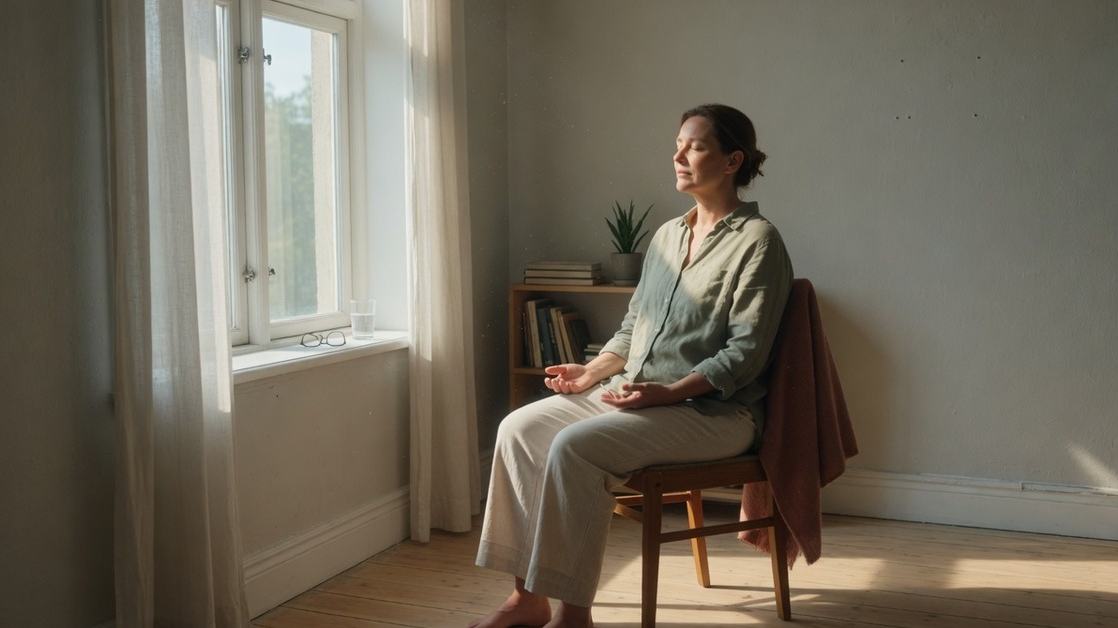
You sit down to work, look up twenty minutes later, and find yourself scrolling something unrelated. Attention drifts — that part is ordinary. What mindfulness practice gives you is something specific to do about it: notice where your attention went, and return it to what you chose to follow. Ten minutes in a chair is a very manageable way to start practicing that move.
The evidence base here is unusually solid for such a simple habit. Zainal and Newman's meta-analysis of 111 randomized controlled trials of multi-session mindfulness programs found small-to-moderate improvements in overall cognition and in several specific skills, including executive attention, sustained attention, and working-memory accuracy. Benefits held up against active comparison groups, not only waitlist or no-treatment groups — a demanding test for any intervention.[1]
Give yourself one thing to follow
The setup is refreshingly small:
- Sit somewhere you can stay comfortably for a few minutes — an ordinary chair is fine.
- Set a timer for ten minutes, or whatever the time you have allows.
- Let your breathing stay completely ordinary and pick one sensation to follow: air passing at the nostrils, or the movement of your abdomen.
- When you notice you have wandered, come back. That is the whole practice.
And you will wander — into dinner plans, a replayed conversation, tomorrow's email written in your head. You do not need to finish the thought first, and you do not need to count how often it happens. Here is an example, not an account of anyone's session: you notice one breath, start thinking about an unanswered message, then realize your attention has moved. Return to the next breath. The message can wait until the timer ends. Every one of those returns is a repetition of the skill, early or late in the sitting.
If the breath is not a comfortable anchor, you have practical alternatives: feel your feet on the floor, or listen to the sounds around you. Keep your eyes open if that is easier. If the exercise increases distress, stop; there is nothing to push through.
What a single ten-minute session did
There is also direct evidence for the short version. Norris and colleagues studied beginners who listened to a ten-minute meditation recording or a control recording, and measured what happened immediately afterward. In one experiment, the meditation group was more accurate on conflicting trials of a Flanker attention task without responding any slower. In another, the meditation group completed an Attention Network Test more quickly without losing accuracy — a genuinely encouraging result for a first sitting, measured in behavior rather than self-report alone.[2][3]
The researchers also recorded electrical brain responses. A particular response to conflicting information was larger among participants lower in neuroticism who meditated, but not among those higher in that trait. Neuroticism simply describes a tendency toward negative emotions such as worry; it is not a diagnosis, and there is no test to take before trying meditation.
The bigger meta-analysis maps where this practice pays off best: attention and working-memory accuracy improved, while processing speed and episodic memory did not shift significantly overall.[1] Attention is where the evidence is strongest — and attention is exactly what most workdays are short of.
Fit the practice around a real day
Choose a slot that already has a boundary built into it, such as after you get home and before you open the evening's messages. Ten minutes is simply the length the brief study used; a shorter sitting is not the same intervention that was tested, but it can be the thing that turns this into a habit you actually repeat.
Keep any note afterward simple: when you sat, whether the slot worked, and whether you want to use it again. Resist grading the session by how empty your mind felt — a busy sitting is a generous one, because it hands you more chances to notice and return.
When the timer sounds, open the document or start the next ordinary task. And if notifications keep pulling you away, improve those conditions too; the single-tasking setup handles that part of the workday, so your ten minutes can do what it does best.