
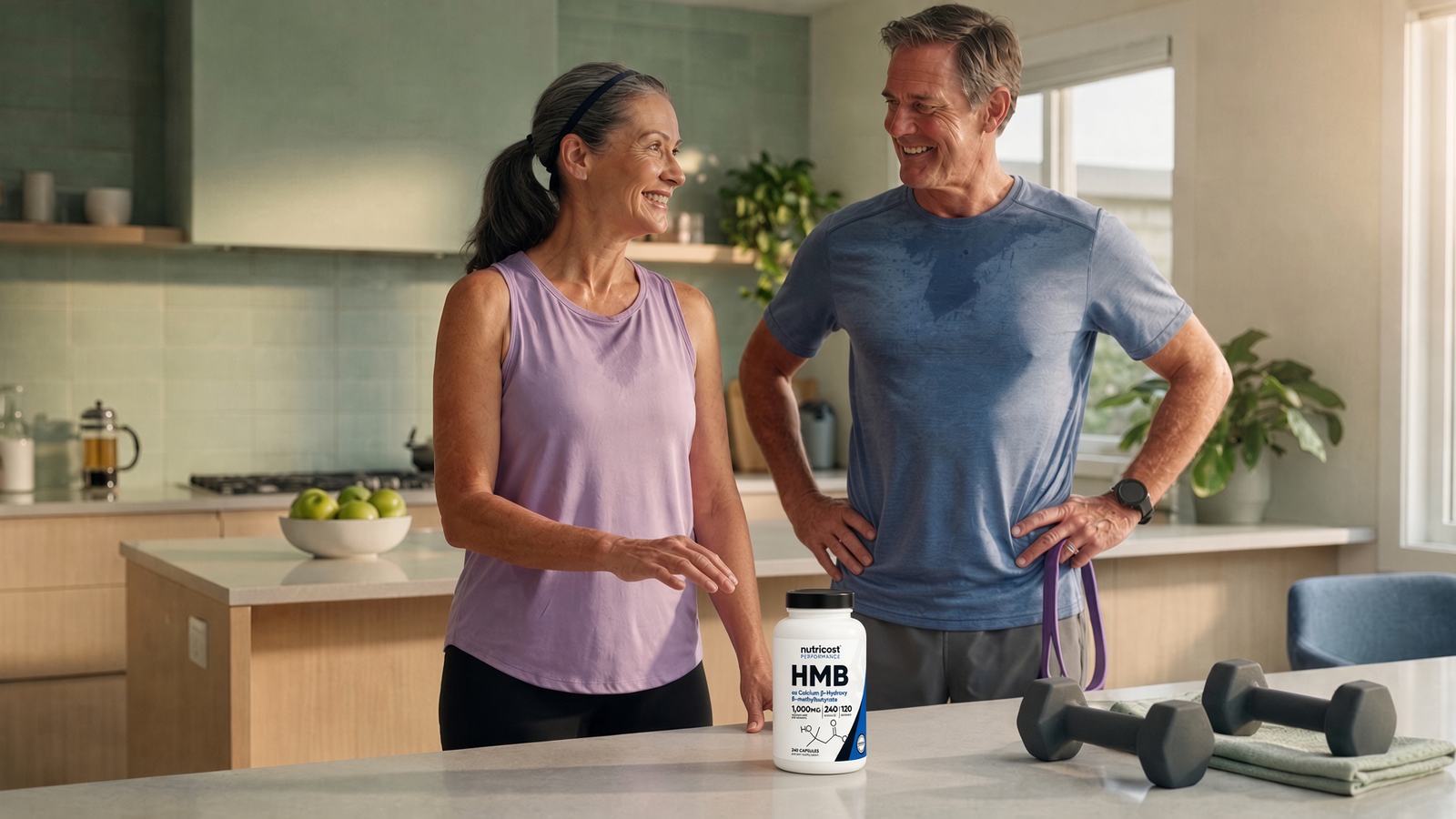
Strength training after 50 pays off in the things you actually do: rising out of a chair, carrying the groceries in one trip, climbing stairs without planning for them, and keeping the capacity for the activities you enjoy. Muscle responds to training at every age, which is the encouraging part. Progressive resistance work comes first. HMB is a possible add-on to that work, not a replacement for it.
Why periods of inactivity matter
Prolonged inactivity can reduce muscle mass, and one bed-rest experiment shows the mechanism more clearly than an ordinary busy week does.[3]
In a randomized, double-blind study of 19 older adults evaluable at the end of the bed-rest period (8 taking placebo, 11 taking calcium HMB), ten days of complete bed rest cost the control group about 2 kilograms of total lean body mass. The calcium-HMB group, taking 1.5 grams twice a day, did significantly better: the difference between the two groups in lean-mass change across those ten days was statistically significant. The near-zero change reported within the HMB group itself came after one participant was excluded. The authors' own conclusion is that HMB preserved muscle mass during those ten days and that the result needs confirmation in a larger trial; this small study does not establish the same benefit for everyone who simply spends more time sitting.[3] The broader and more useful message is the one you can act on: movement protects what you have.
Build a manageable training week
Give resistance work a place alongside walking and balance practice. Choose movements you can perform with control, and increase the challenge gradually. Walking contributes real activity, and strengthening the major muscle groups adds something walking alone does not.
Adults need at least 150 minutes of moderate activity each week and at least two days of muscle-strengthening work, and older adults should add balance activity too.[9] Those targets are generous enough to build a week around your ability and schedule:
- Walk like it counts. Brisk enough that talking is possible and singing is not.
- Strengthen major muscles at least twice a week — legs, hips, back, chest, and arms.
- Practice balance in a safe setting, with support available if needed.
- Eat enough protein. Training needs raw material.
- Treat any supplement as support for that work, not a stand-in for it.
HMB can support that work. The work is still what drives the result.
Plan around interruptions
Put the strengthening sessions on the calendar first and fill the remaining gaps afterward. If travel or work disrupts a session, pick another workable time rather than writing off the week. Illness, injury, or medically required rest calls for an appropriate recovery plan, not a rushed replacement workout.
What HMB Adds — and What It Does Not
HMB, or beta-hydroxy beta-methylbutyrate, is made from leucine, an amino acid in protein foods. About 5 percent of the body's leucine becomes HMB. Experts believe that path helps the body build muscle protein and slow its breakdown. The National Institutes of Health reports general agreement that HMB can help the body recover from exercise hard enough to damage skeletal muscle, and notes no safety concerns reported at the typical 3 grams a day for up to two months. Some studies also point to strength, power, muscle growth, and aerobic performance, with trial results described as conflicting.[1]
The amount studied most often is 3 grams a day. It comes as calcium HMB or free-acid HMB. Calcium HMB is about 13 percent calcium by weight.[1]
That is the add-on. The lifting, walking, and standing still come first.
The pooled evidence in people over 50 is genuinely positive. A 2025 meta-analysis of 21 randomized trials and 1,935 adults older than 50 found HMB associated with more appendicular skeletal muscle mass (1.56 kilograms), more lean mass (0.28 kilograms), a stronger handgrip (0.54 kilograms), a faster five-time chair stand (0.73 seconds), and a slightly faster walk (0.06 meters per second). The significant improvements showed up at 3 grams a day and with supplementation lasting longer than 12 weeks, which is the regimen those authors recommend. Worth pairing with it: NIH reports no safety concerns at the typical 3 grams a day for up to two months, and states that there is no expert consensus on the value of taking HMB for several months or longer or on its safety.[1] A duration chosen for pooled research outcomes is therefore not a safety clearance and not a personal dose. These are pooled averages, not a promise that every person will see the same change.[2]
People with diagnosed age-related muscle loss, called sarcopenia, have their own results. Across five randomized trials, four of them rated at low risk of bias, HMB was tied to a higher skeletal muscle mass index and a stronger grip. Gait speed did not improve in that analysis; mass and strength did, and the authors describe the evidence as beneficial but limited.[4]
A 2025 umbrella review of 11 meta-analyses in adults aged 23 to 79 also found significant pooled gains in muscle mass, fat-free mass, and a muscle strength index, with no significant change in fat mass or body weight.[5]
Build the Habit First. Then Support It.
Here is the most directly relevant question: does adding HMB to training beat training alone? A 2025 meta-analysis of ten trials with 596 older adults compared resistance training plus HMB with resistance training alone. It found a moderate improvement in Short Physical Performance Battery scores and a small, borderline improvement in grip strength, with no significant added benefit for gait speed, appendicular lean mass, muscle quality, fat mass, or body weight. Half the trials were rated at high risk of bias. That makes HMB a promising add-on for selected outcomes rather than a reliable upgrade to every result of training.[8]
Some findings belong to combination products, and those results should stay with those products:
- In a 12-month study of adults over 60 with insufficient vitamin D, calcium-HMB plus vitamin D3 improved lean body mass and a composite functional index among participants who were not exercising. Those who exercised did not gain further on that index. This was an HMB-plus-vitamin-D result, not HMB alone.[6]
- The NOURISH trial studied 652 malnourished adults 65 and older hospitalized for heart or lung conditions. A high-protein drink containing HMB improved nutritional status at day 90 and body weight at day 30, and 90-day mortality was 4.8 percent with the formula versus 9.7 percent with placebo, although the primary composite endpoint did not differ. The test covered the complete formula, not isolated HMB.[7]
Keep your own week simple:
- Put two muscle-strengthening days on this week's calendar.
- Add walking or other moderate activity toward 150 minutes.
- Keep protein in the meals that surround that work.
- If considering HMB, distinguish the commonly studied 3 grams a day from a personal recommendation, and check whether a supplement fits your health needs and existing care.
During illness, malnutrition, or medically required inactivity, supplementation belongs within the care and rehabilitation plan. The bed-rest and hospital studies are not instructions to manage those situations with HMB alone.
Start with the training plan
Choose the strengthening sessions you can realistically keep, the equipment or support you need, and the movements you want to improve. Keep food and recovery in that plan. Consider HMB after those foundations are in place, with expectations tied to the populations and outcomes actually studied. The first two sessions on the calendar are the ones that change the most.
Sources
- https://ods.od.nih.gov/factsheets/ExerciseAndAthleticPerformance-HealthProfessional/
- https://pubmed.ncbi.nlm.nih.gov/40248035/
- https://pubmed.ncbi.nlm.nih.gov/23514626/
- https://pubmed.ncbi.nlm.nih.gov/39999663/
- https://pubmed.ncbi.nlm.nih.gov/39797501/
- https://pubmed.ncbi.nlm.nih.gov/32857128/
- https://pubmed.ncbi.nlm.nih.gov/26797412/
- https://pubmed.ncbi.nlm.nih.gov/41305674/
- https://www.cdc.gov/physical-activity-basics/guidelines/older-adults.html