
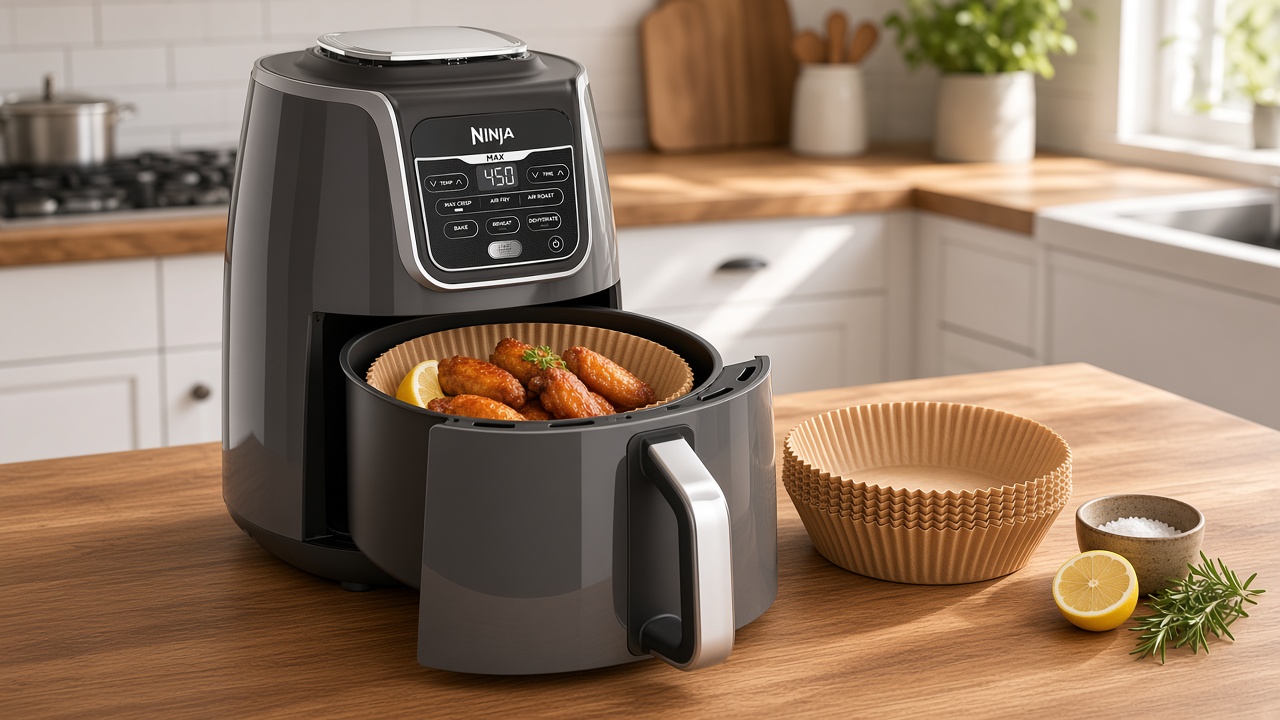
I bought my Ninja Air Fryer Max XL in August 2022, and I've been sanctifying a good share of what I eat in it ever since. I love crispy everything. Wings, potatoes, fish, leftover pizza. If it can come out crunchy, it goes in the basket. On October 11 of this year I reordered another box of 1,000 paper liners for it.
For a long time the basket got a sheet of aluminum foil first. It saved me some scrubbing and I never gave it a second thought. Then I found out that hot foil and a squeeze of lemon don't get along very well, so I switched to round parchment liners. They're cleaner, and I feel better using them. At $35.99 for 1,000, each one costs about 4 cents.
Why foil and lemon don't mix
Foil isn't poison, and it's fine for wrapping leftovers. The trouble starts when it's hot and pressed against something acidic or salty, because acid and salt help pull aluminum out of the foil and into the food. [1,3] Lemon on wings counts. So does a vinegar marinade.
Germany's Federal Institute for Risk Assessment (BfR) advises against letting acidic or salty foods touch foil, and suggests a paper layer between the food and the foil if you use it at all. [5] A paper liner does that job with no foil involved, so that's where I landed.
What the research measured
- Bassioni et al., 2012. In one study, researchers boiled strips of foil for two hours in a meat broth with tomato juice, citric acid and salt. That's a harsh lab test, nothing like a normal recipe. The acidic broths pulled out much more aluminum, and adding spices pushed it higher still. The estimated intake per serving went from about 132 mg to 537 mg. The authors said foil is fine for packing food but not for cooking it, especially when the food is acidic. [1]
- Ranau et al., 2001. In another study, fish cooked in foil came out with 2 to 68 times more aluminum than it started with. Spiced mackerel had the biggest jump. The researchers still judged the risk to be low. [2]
- Czech Journal of Food Sciences, 2019. In a study of baked fish, leaching went up as the acid and the heat went up. Levels stayed under safety limits. The authors did point out that kids, older people and people with kidney disease are more vulnerable. [3]
For a sense of scale, the European Food Safety Authority puts the tolerable weekly intake at 1 mg of aluminum per kilogram of body weight, and plenty of Europeans already reach that from ordinary food. [4] My wings aren't a crisis. Foil was just an easy source to cut, and cutting it cost me nothing.
How I use the liners in my Ninja
Mine is the Ninja Air Fryer Max XL, model AF161, the 5.5-quart one. It lists at $164.66 right now, and I've used it steadily for over three years. Ninja's own FAQ for the Max XL line says parchment and foil are both fine in the basket, so I wasn't breaking any rules with the foil. [8]
Most of the time the liner never touches my food. It lies flat in the bottom of the basket, and the metal rack goes right on top of it, so the paper can't slide around or lift. Grease and drips land on the liner. Air still gets under the food, and it crisps on every side instead of sitting in its own juice. I do it in this order:
- Liner in. Flat in the bottom of the basket.
- Rack on top. It sits right on the liner and pins it down.
- Food on the rack. Lemon juice and grease drip through onto the paper.
- Wash the rack. I toss the liner and give the rack a quick wash. The basket stays clean.
Now and then I leave the rack out and set the food right on the liner. When I do, I spread the food across the whole liner so it stays put. The wings come out crispy either way, and that was the one thing I wasn't willing to give up.
A couple of cautions
Reynolds makes its own liners, and it says never to run one by itself. The moving air can lift an empty liner into the heating element, which is a fire hazard. [6,7] Their instructions are written for a liner with food sitting on it. In my basket, the liner is always held down by the rack or by the food, and it never goes in empty. Keep it flat, too. A liner that's too big, or one crumpled up the sides, can block the airflow, and that's how you end up with soggy food. [6]
Reynolds rates its liners to 400°F. The Max Crisp setting on my Ninja runs hotter than that, so check the box on whatever liners you buy. If you use Max Crisp, skip the liner unless the box says it can take the heat. [6]
Why I keep reordering
My cooking didn't really change when I switched. The cleanup got easier and the foil went away. I squeeze lemon on whatever I want now and don't think twice about it. For what a box costs, it's the cheapest upgrade I've made in my kitchen in a while.
I haven't put foil back in the basket since.
Sources
- Bassioni G, et al. Risk Assessment of Using Aluminum Foil in Food Preparation. Int J Electrochem Sci. 2012;7:4498-4509
- Ranau R, et al. Aluminium levels of fish fillets baked and grilled in aluminium foil. Food Chemistry. 2001
- Effects of different pH, temperature and foils on aluminum leaching from baked fish by ICP-MS. Czech Journal of Food Sciences. 2019
- EFSA: Safety of aluminium from dietary intake
- BfR: FAQs about aluminium in food and products intended for consumers
- Reynolds: Can I put parchment paper in an air fryer?
- Reynolds: How to use air fryer liners
- Ninja: Air Fryer Max XL FAQs