
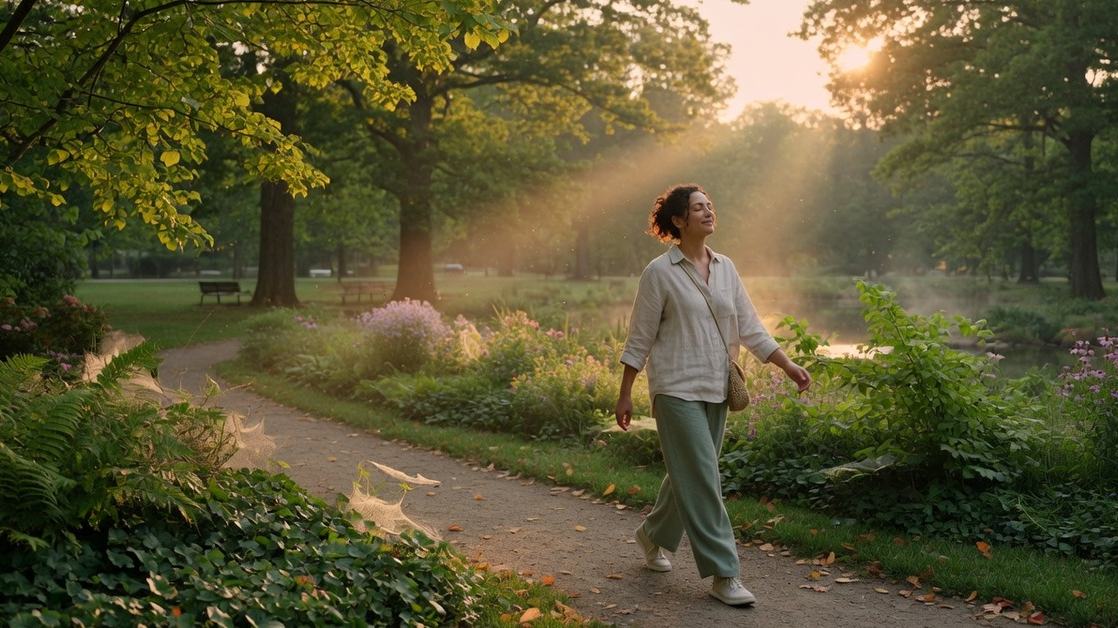
A morning walk is one of the easiest good habits to start: it costs nothing, needs no gear, and it begins at your own front door. Choose a route that fits neatly between getting ready and leaving for work — a park if one is nearby, or a safe sidewalk loop from home. In ten or fifteen minutes you put daylight and movement into a part of the day that would otherwise happen entirely indoors.
Three ingredients come together on that walk, and each has its own research behind it: morning daylight, physical activity, and time in green space. One trip outdoors collects all three.
Fit daylight to your own sleep schedule
Light is the strongest signal your body clock responds to, and morning is when you can put it to work. For people who normally sleep at night, bright light around morning wake time tends to shift the body clock earlier, while bright evening light tends to shift it later. CDC/NIOSH guidance notes that the effect is less predictable in the hours before your usual wake time, so the useful reference point is your own schedule rather than the hour on the clock.[1]
There is a striking illustration of how much the light environment matters. A study of exposure to a natural light-dark cycle found earlier circadian timing during summer camping than in participants' usual electrically lit surroundings. It looked at the whole day, evenings included, rather than a brief walk in isolation — a good reminder that generous daylight early and dimmer light late work as a pair.[2]
If you work nights, treat this as a daytime-worker routine rather than a light-treatment plan for shift work or a sleep disorder.
Take the pleasant route when you can
Where you walk can add something of its own. A 2018 paper reported two field studies on nature trails in Finland, where participants walked four to six kilometers, with or without added psychological tasks. Mood and self-reported restoration improved after walking; the added tasks brought no extra benefit on those measures, and sustained-attention results varied with the conditions.[4]
The practical takeaway is encouraging either way. When a green route is available, take it and enjoy it. When only an ordinary street is on offer, go anyway — physical activity is good for your brain in its own right.[5]
Plan for the morning you actually have
A little planning the night before is what turns this from a nice idea into a routine you keep.
- Count the real minutes. Include getting out the door and back, and build the slot around your sleep so the walk adds to your morning instead of borrowing from your night.
- Pick a route you trust. Think about traffic, footing, heat, and weather, and set a pace and distance that suit you today.
- Make it one decision, not five. Shoes by the door and the route chosen in advance leaves the morning rush nothing to figure out.
- Keep a plan B. If conditions are poor, move indoors and save the outdoor version for the next good morning.
You collect the daylight simply by being outside; there is no need to look at the sun. The route does not have to be scenic, and the walk does not have to become a workout before the workday begins. An easy pace still counts.
Keep the version that fits
After a week, ask two simple questions: did you get out most days, and did the rest of the morning still work? If it felt rushed, shorten the loop or move your movement to another time of day. The routine worth keeping is the one that fits comfortably around your sleep and your responsibilities — and that is usually the one you are still doing a month from now.
Sources
- https://www.cdc.gov/niosh/work-hour-training-for-nurses/longhours/mod2/19.html
- https://pmc.ncbi.nlm.nih.gov/articles/PMC4020279/
- https://pmc.ncbi.nlm.nih.gov/articles/PMC6751071/
- https://www.frontiersin.org/journals/psychology/articles/10.3389/fpsyg.2018.02057/full
- https://www.cdc.gov/physical-activity/features/boost-brain-health.html
Additional sleep background: Scofa — What Is Circadian Rhythm?