
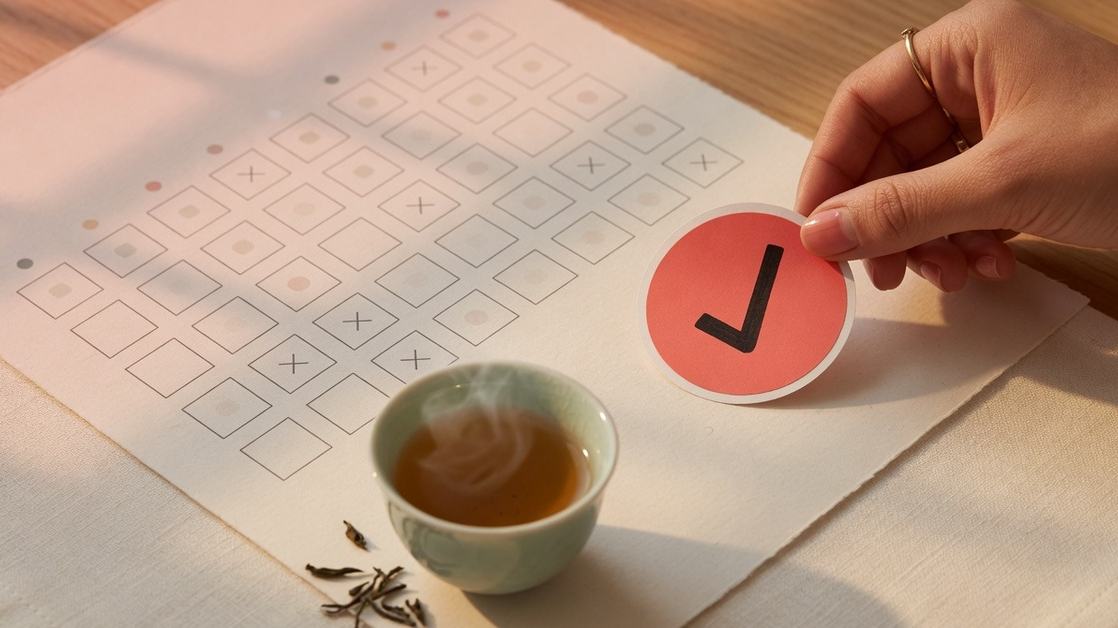
Here is an encouraging way to think about any habit you are building: the part you control most is today's session. The distant payoff — better health, a new skill, a calmer week — is a fine reason to start, and the experience of the next twenty minutes is what brings you back tomorrow. Improve that experience and the habit starts working for you.
So the most useful question is which part of the activity you can make more satisfying right now: a pleasanter place to practice, a form of movement you actually enjoy, equipment that is comfortable to use.
Separate the future benefit from today's experience
This split is worth making, and there is research behind it. In Woolley and Fishbach's work on long-term goals, immediate rewards such as enjoyment were more strongly associated with persistence than delayed rewards. The studies covered exercise, studying, and New Year's resolutions. Future benefits helped explain why people chose their goals; immediate experience was more closely related to sticking with them.[2]
That gives you two clear questions to keep on hand:
- Why is this activity worth keeping? This is your reason to begin, and it can stay big and long-range.
- What is it like while I am doing it? This is your reason to return, and it is the one you can improve this week.
A strong answer to the first is genuinely valuable. Improving the second is what turns a good intention into a routine you look forward to.
Change one part of the session
Small, well-chosen adjustments do a lot of work here. Pick the one that fits your task:
- For movement: switch to a route or an activity you prefer. A walk you enjoy beats a workout you dread.
- For practice: choose material that interests you while still training the skill you are after.
- For routine work: remove one avoidable annoyance from the setup — the cluttered desk, the tangled cable, the app you have to hunt for.
Try one adjustment at a time so you can tell what actually helped, and match it to the task: background entertainment suits a repetitive chore, while difficult reading rewards a quiet setup. The simplest changes are usually the ones that last, and they cost less time than an elaborate reward arrangement.
A progress mark and a reward do different jobs
Recording a completed action tells you what happened, and that is useful on its own. Harkin and colleagues' meta-analysis found that interventions encouraging progress monitoring improved goal attainment on average, with larger effects when information was physically recorded or outcomes were reported. Encouragingly, the simplest versions carry the strongest support: write it down, or tell someone.[1]
So keep a brief record and let it earn its place at the end of the week, when you can look back and see the pattern. A truthful note is valuable even when the session felt ordinary — in fact, those are the entries that show you the habit is real.
If you add a reward, pay attention to its timing
Timing looks like it matters. Experiments on the activities studied compared earlier and later rewards, and earlier rewards could increase intrinsic motivation — a promising idea to test on your own routine.[3]
What a reward communicates matters too. A meta-analysis found that some expected, tangible rewards reduced freely chosen engagement, while positive feedback improved it.[5] That is encouraging: the cheapest option on the list — noticing and naming what went well — is also one that helped.
Choose something modest that you genuinely want and can sustain at the same size week after week. Then review the real effect with three quick checks:
- Was starting easier?
- Was the session itself better?
- Did you come back?
If the answers are yes, you have found something worth keeping. If they are mixed, improve the activity rather than raising the payout — that is where the leverage is.
The long-term benefit is still a real reason to act. Making the action enjoyable today gives you a reason to come back long before that benefit arrives, and that is what carries a habit forward.
Sources
- Harkin B, et al. "Does Monitoring Goal Progress Promote Goal Attainment? A Meta-Analysis of the Experimental Evidence." Psychological Bulletin (2016). https://doi.org/10.1037/bul0000025
- Woolley K, Fishbach A. "Immediate Rewards Predict Adherence to Long-Term Goals." Personality and Social Psychology Bulletin (2017). https://doi.org/10.1177/0146167216676480
- Woolley K, Fishbach A. "It's About Time: Earlier Rewards Increase Intrinsic Motivation." Journal of Personality and Social Psychology (2018). https://doi.org/10.1037/pspa0000116
- Judah G, Gardner B, Aunger R. "Exploratory Study of the Impact of Perceived Reward on Habit Formation." BMC Psychology (2018). https://doi.org/10.1186/s40359-018-0270-z
- Deci EL, Koestner R, Ryan RM. "A Meta-Analytic Review of Experiments Examining the Effects of Extrinsic Rewards on Intrinsic Motivation." Psychological Bulletin (1999). https://doi.org/10.1037/0033-2909.125.6.627