
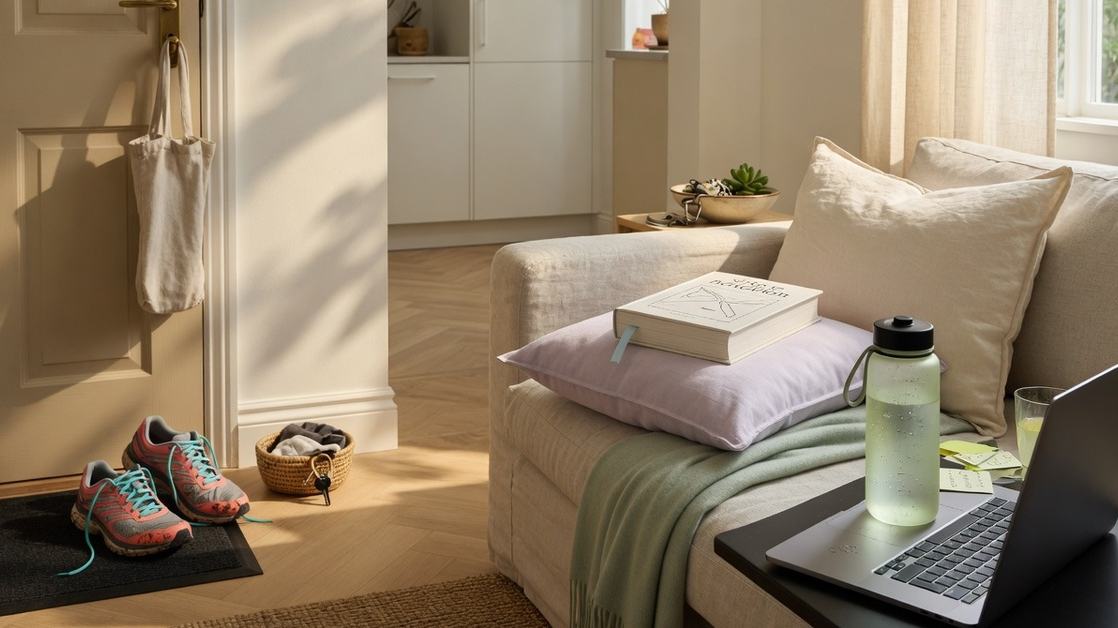
The best habit reminder shows up right when you can act on it. Walking shoes beside the door you leave through for an evening stroll are a ready invitation. Put the cue where the action happens, give it one clear job, and have the equipment waiting, and a new routine gets much easier to start.
Pair the object with a moment
Choose a specific pairing you will meet every day:
- A book on the chair where you read after dinner.
- A water bottle beside the materials you use at your desk.
- A yoga mat unrolled next to the spot where you finish your morning coffee.
These are setup ideas to adapt to your home. Keep walkways clear and medicines stored safely.
Then give the object a clear instruction. A book on the chair could mean read a page, pack it for the commute or put it away. Decide in advance: "When I sit here after dinner, I read one chapter." Now the cue tells you exactly what to do.
Try pairing two cues
In an exploratory study, 39 participants were asked to take a vitamin C tablet every day for three weeks and were then interviewed about how they remembered. Many chose visible or convenient objects as reminders, and finding the cue that worked often took some experimenting. The researchers suggested combining clearly defined cues.[3]
That gives you a practical upgrade when a setup is not quite clicking. Pair the visible object with a routine event that already happens: opening your work bag, finishing lunch or sitting down in the reading chair. Keep a helpful second prompt; together, the two make the moment unmistakable.
Troubleshoot the weak link
If the habit still slips, find where the chain breaks and fix that one step:
- You did not notice the cue. Move it to the place you actually use, not the place you meant to use.
- You noticed but could not act. Shift the prompt to a moment when you can respond. A notification during a drive can wait until you are parked.
- You were unsure what to do. Make the instruction specific enough to start without another decision.
- You started but could not finish. Trim the action, swap the equipment or choose a better setting.
Keep a winning setup steady
A 2022 paper tested a context-stability intervention with university students and analyzed data from a habit-building app. In both, doing the behavior in a stable context predicted greater automaticity and more success reaching repetition goals.[4] Repeating an action in the same workable setting helps it become second nature.
So once the cue reaches you and the action fits, leave the setup alone and let the repetitions build. Measure success by completed actions, not by how tidy the space looks. When your schedule shifts, move the cue into the new routine so it keeps reaching you at a moment you can act.
Sources
- Lally P, van Jaarsveld CHM, Potts HWW, Wardle J. "How are habits formed: Modelling habit formation in the real world." European Journal of Social Psychology — https://doi.org/10.1002/ejsp.674
- Wood W, Tam L, Guerrero Witt M. "Changing circumstances, disrupting habits." Journal of Personality and Social Psychology — https://pubmed.ncbi.nlm.nih.gov/15982113/
- Stawarz K, Gardner B, Cox A, Blandford A. "What influences the selection of contextual cues when starting a new routine behaviour? An exploratory study." BMC Psychology — https://pmc.ncbi.nlm.nih.gov/articles/PMC7106637/
- Stojanovic M, Grund A, Fries S. "Context Stability in Habit Building Increases Automaticity and Goal Attainment." Frontiers in Psychology — https://doi.org/10.3389/fpsyg.2022.883795
- Wood W, Rünger D. "Psychology of Habit." Annual Review of Psychology — https://doi.org/10.1146/annurev-psych-122414-033417