
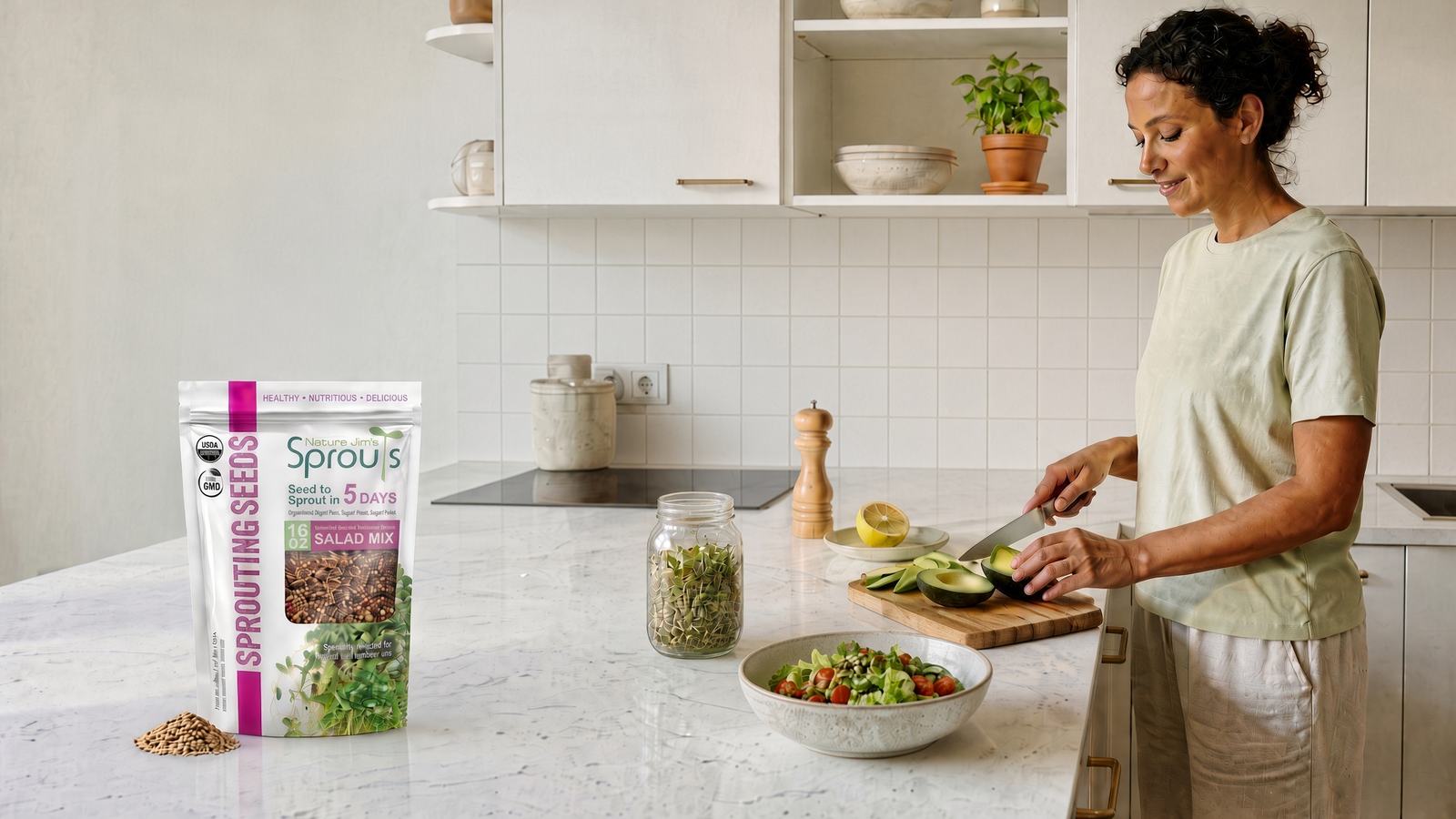
The five-day project that took over my counter
I started growing sprouts in my 50s, and I enjoy it. I did not expect a jar of seeds to become a quiet point in my week, but rinsing and harvesting them has done exactly that—and Nature Jim's Salad Mix is the bag I keep coming back to.
The work itself is plain, which is the appeal. I start the seeds, watch them, and in four or five days I harvest. The Nature Jim's Salad Mix listing says it can produce home-grown sprouts in as little as five days, and that matches what happens on my counter.[1] Nature Jim's notes that all four varieties sprout at nearly the same pace, which is why one jar of this blend stays simple to manage, and that letting them grow another two to five days gives a more pronounced flavor.[2] Watching a seed turn into food you can eat is satisfying on its own. It also happens fast enough that you never sit around waiting for the story to start.
A few handling habits are worth building in from the first batch. Wash your hands with soap and warm water for at least 20 seconds before and after handling sprouts, and rinse the sprouts under running water—not with soap, detergent, or produce wash, which the FDA does not recommend for any produce. Keep harvested sprouts refrigerated at 40 degrees F or below, and store them away from raw meat, poultry, and seafood.[4]

What is in the bag
The Nature Jim's Salad Mix is a four-seed blend of broccoli, alfalfa, clover, and radish, sold in a one-pound package.[1] Nature Jim's describes the flavor balance as mild, nutty, and spicy.[2]
That mix is the whole idea. You are not growing one flat-tasting green and calling it a salad. Each seed brings something different to the jar:
- Alfalfa and clover for the fresh, mild base of the blend.[2]
- Broccoli for a subtle nuttiness.[2]
- Radish for the peppery kick that wakes up a sandwich.[2]
The bag is one product. The plate is four sprouts at once.
What sprouts bring to a plate
I like this product. It is a healthy addition to our meals.
A peer-reviewed review calls broccoli sprouts, and sprouts in general, an excellent source of protein, vitamins, minerals, fiber, and especially phytochemicals.[3]
The broccoli sprout question
Broccoli sprouts get singled out for one reason in particular. They are a convenient and rich source of glucoraphanin, which the plant can convert into sulforaphane—a compound researchers have spent a great deal of time studying, and one the same review describes as a potent inhibitor of carcinogenesis in multiple animal models.[3] That research is about sprouts and their constituents in general, in laboratory and trial settings, not a tested nutrition profile or health result for this commercial blend.
Washing, handling, and eating
The washing is my favorite part, which sounds strange until you try it. Rinsing the harvest and floating off most of the seed husks is calm, repetitive work. This takes a little bit and is what I enjoy—the quiet rinsing. Then the sprouts go straight into a salad or onto a sandwich. You get plenty so you can store and use them every day. In the meantime, you are growing more.
Why I keep telling parents about this
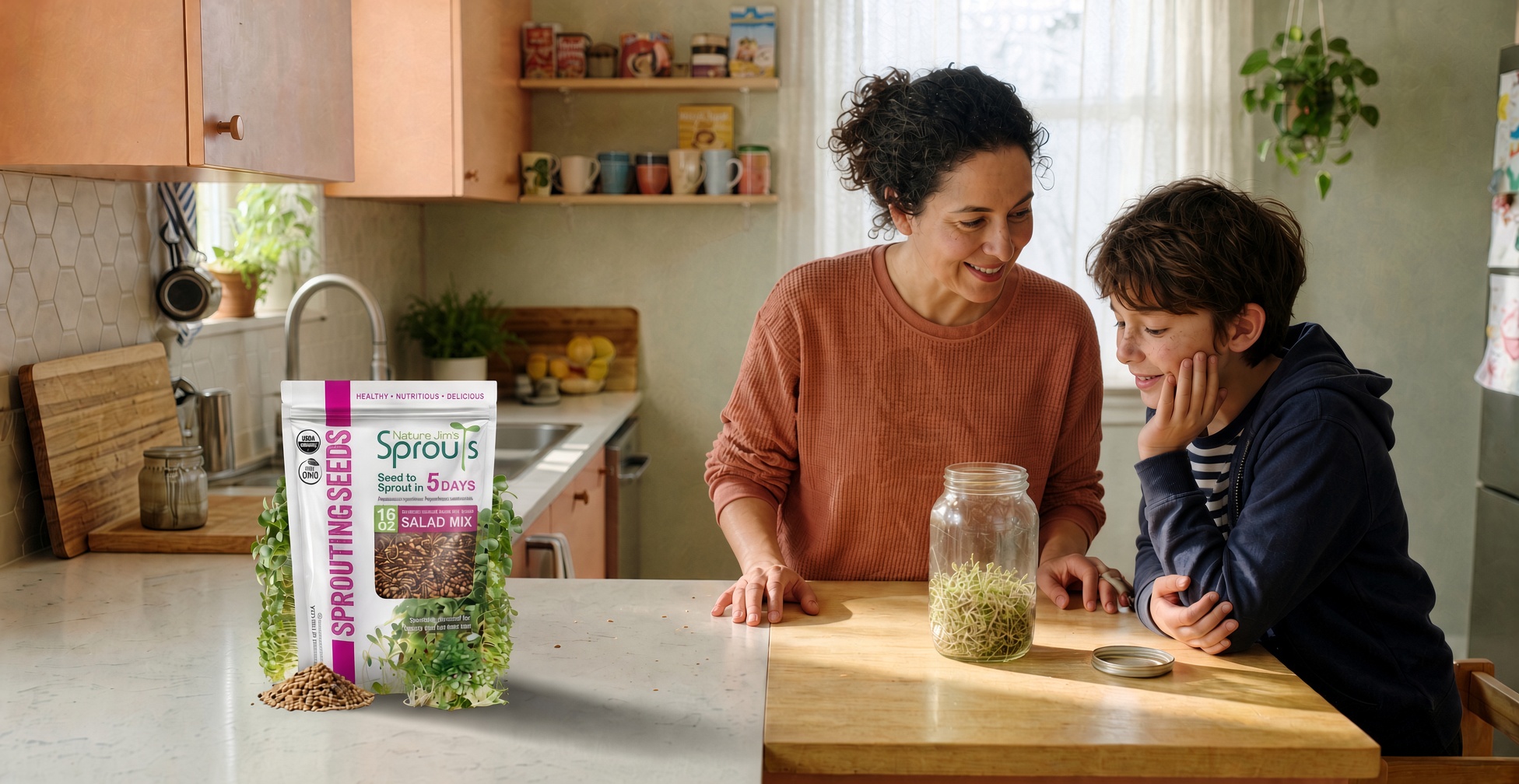
If you have kids, this is a joy to show them. They get genuinely excited watching the growth, and it happens on a timeline a child can actually follow. You start a jar. You rinse. You wait a few days. Then there is food on the counter that was seeds at the beginning of the week. Growing and watching the jar is a separate question from what ends up on a child's plate raw.
On that point, one caution matters and it is worth stating plainly. Sprouts grow in the warm, humid conditions that also suit Salmonella, Listeria, and E. coli, and the FDA notes that bacteria present on the seed can multiply during sprouting even when you grow your own under sanitary conditions at home; rinsing removes surface debris but does not eliminate bacteria. Food-safety guidance is that children, older adults, pregnant women, and people with weakened immune systems avoid raw or lightly cooked sprouts, and that sprouts be cooked thoroughly.[4]
If you want to start your own jar
This blend fits well if you:
- Eat a lot of salads or sandwiches and want fresher greens on them
- Like small kitchen projects that finish in under a week
- Want a peppery, nutty flavor instead of one plain green
- Have children or grandchildren who would enjoy watching food grow
If fresh salads, better sandwiches, and a small kitchen-growing project sound good to you, the one-pound Nature Jim's Salad Mix is on Amazon and it is an easy place to start.[1]
Sources
- Nature Jim’s Sprouts Salad Mix, 1 lb — Amazon product listing
- https://www.naturejims.com/seeds/salad-mix-sprouting-seeds
- https://www.frontiersin.org/journals/nutrition/articles/10.3389/fnut.2021.648788/full
- https://www.fda.gov/food/buy-store-serve-safe-food/selecting-and-serving-produce-safely