
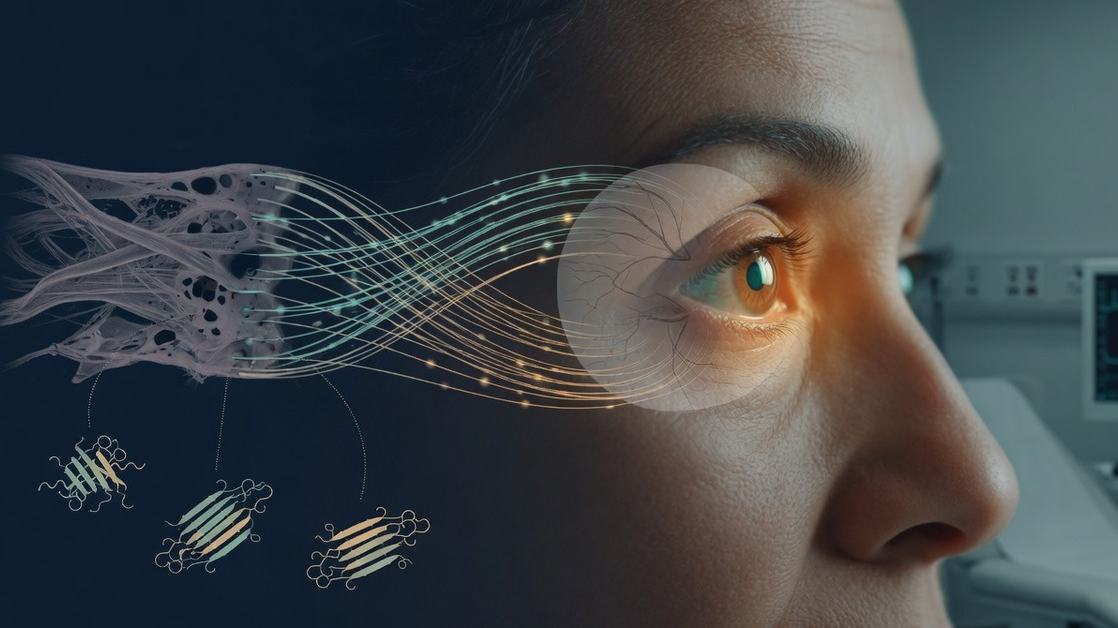
A person has received ER-100 in one eye, and with that first dose one of the boldest ideas in aging biology stepped out of the laboratory and into human evidence. ER-100 is an experimental gene therapy designed to help damaged nerve cells in the eye recover a more youthful, functional pattern of gene activity, using three reprogramming factors—OCT4, SOX2 and KLF4, together called OSK—to restore function without changing what kind of cell it is.
The immediate goal is not immortality, a younger body, or even proof that lost vision can be restored. The first task is more focused and more serious: begin assessing whether a controlled form of cellular reprogramming is safe and tolerable in people. That is exactly how genuinely new medicine starts, and getting here is an achievement in itself.
Behind that first dose sits a question with enormous implications: What if some age-related nerve damage is not as permanent as we once believed?
The idea that refused to stay in the laboratory
David Sinclair and other researchers have argued that aging cells lose some of the instructions that once helped them function properly. Aging cells also accumulate DNA damage, but this hypothesis points at something different and more hopeful: the epigenome, which helps control when genes switch on and off, may become less orderly over time — and information that has been scrambled might, in principle, be restored.
In 2020, Yuancheng Lu, Sinclair and colleagues reported a striking set of results in Nature. In mouse experiments, OSK expression reversed some age-associated DNA-methylation and gene-expression changes in retinal ganglion cells, promoted optic-nerve axon regeneration after injury, and improved visual function in glaucoma and aging models.
That did not prove the same thing would happen in people. It did something more useful: it gave researchers a concrete reason, and a concrete method, to take the next step.
Life Biosciences, the company Sinclair co-founded, developed the approach into ER-100. Here is how the therapy is designed to work:
- Delivery. A modified adeno-associated virus (AAV) carries OSK instructions into retinal ganglion cells.
- Administration. A single injection into the vitreous of one eye.
- Control. Participants take doxycycline for eight weeks to activate an inducible genetic switch and turn OSK expression on, which means the effect is meant to be started and stopped deliberately rather than left running.
- Intent. Partial reprogramming — helping an old or damaged retinal cell recover a more youthful operating pattern while remaining a retinal cell, not returning it to a stem cell.
That control switch is one of the most encouraging engineering details in the program: it turns a dramatic biological idea into something a trial can dose, measure and stop.
Why begin with the eye?
The eye is not only a window into the body. For this research, it is close to an ideal proving ground:
- The therapy can be delivered locally, to one eye, rather than throughout the body.
- The tissue can be examined in extraordinary detail using standard clinical imaging.
- Function is measurable — visual acuity, visual fields, contrast sensitivity, retinal function and retinal structure can all be tracked over time.
- The need is real and unmet, which makes a careful early trial worth running.
ER-100 is being tested in people with open-angle glaucoma and non-arteritic anterior ischemic optic neuropathy, known as NAION. Both damage retinal ganglion cells, the neurons that carry visual information from the eye to the brain. Glaucoma treatments can lower pressure inside the eye and slow further injury, but they do not rebuild an optic nerve that has already been damaged, and progression often continues despite treatment. NAION is the most common acute optic neuropathy in adults over fifty; it causes sudden, painless vision loss, and there is no approved treatment that restores what was lost.
ER-100 is not expected to resurrect dead cells. The hope is narrower and more plausible: that surviving but damaged retinal ganglion cells and their axons can recover function.
Before reaching people, Life Biosciences reported findings from nonhuman primates with an NAION-like injury, including controlled OSK expression and improvements in pattern electroretinogram measurements of retinal function. Those results were presented by the company and are not peer-reviewed proof of restored vision or clinical benefit — but they were strong enough to carry the question into a human test.
What the first dose actually means
The Phase 1 study is a deliberately small, carefully staged safety trial. Its published design tells you a lot about the caution built into it:
- 18 adults planned, aged 40 to 85, in an open-label, non-randomized, sequential study.
- Glaucoma participants go first, in a dose-escalation phase testing a low dose and a higher dose.
- Each dose level starts with a single sentinel participant, with additional participants enrolled only after a safety committee reviews the results.
- A dose is then selected for the NAION group, which begins with three participants and may expand to six after further safety review.
The study's first job is safety: tracking side effects, eye health, laboratory results including liver function, and any dose-limiting problems, alongside the measures of visual function. The trial is actively recruiting.
So the first participant being dosed is not evidence that ER-100 works. It is evidence that the idea has become testable in humans — and that is the threshold every medicine that eventually changed lives had to cross. Enough evidence to justify trying; nowhere near enough to know the outcome. The trial must now watch closely for immune reactions, inflammation, eye complications and other unintended effects of the gene therapy and its reprogramming system.
David Sinclair's real connection
Sinclair is not a famous longevity researcher commenting from the sidelines. He is a Harvard Medical School genetics professor, a co-founder and board member of Life Biosciences, and a senior author of the 2020 mouse study; the company says its OSK platform was invented in his laboratory. His scientific connection is direct, and so is his financial and institutional one. Readers deserve both facts, and neither one determines whether ER-100 succeeds.
What matters is that a provocative scientific idea completed enough laboratory, animal and manufacturing work to earn authorization for an early human trial. That trial will now produce the evidence.
What this means for the average person
For most of us it changes nothing about medical care today. ER-100 is experimental, available only through a clinical study, and aimed at adults who meet specific criteria for moderate-to-advanced open-angle glaucoma or recent NAION. It has not been shown to restore human vision. The useful actions right now are the ordinary, proven ones:
- Keep taking prescribed glaucoma treatment. Do not stop or pause it because a trial has begun.
- Keep routine eye examinations. Glaucoma can progress well before a person notices symptoms, which is precisely why scheduled checks protect sight.
- Do not seek doxycycline or unapproved gene therapies on the strength of this news; the drug here is only a switch inside a controlled study protocol.
- Ask an ophthalmologist if you think you may qualify for a trial — a specialist can tell you what is realistic for your eyes.
What has genuinely changed is the state of the question. Partial epigenetic reprogramming has lived until now in cells and animals. With ER-100, researchers can begin learning how the human body responds: whether controlled OSK expression is tolerable, whether the delivery system behaves as intended, whether retinal cells show useful changes, and whether any signal of improved function appears.
If the therapy proves acceptably safe, larger and better-controlled studies can ask whether it preserves or restores vision. If those succeed, researchers may explore whether similar approaches help other tissues damaged by age — a leap that would bring its own problems of delivery, dosing, preserving cell identity and risks that may never show up in an eye.
The bright future here is not a promise that aging will soon be reversed. It is something more concrete and, for anyone who cares about what medicine can eventually do, more exciting: the possibility that in selected tissues and diseases, medicine might learn to recover function once thought permanently lost. One participant cannot answer that. But with the first dose of ER-100, the answer has started moving from animal experiments into human evidence.
Sources
- Life Biosciences: First participant dosed in the Phase 1 ER-100 trial
- ClinicalTrials.gov: NCT07290244
- Nature/PubMed: Reprogramming to recover youthful epigenetic information and restore vision
- Life Biosciences: Nonhuman-primate ER-100 findings presented at AAO
- Life Biosciences: David Sinclair and the company’s OSK platform